Entry · Ref W-FUHFQA
What to Look for When Choosing a Dune Buggy in Dubai
- Posted
- 2026-11-16
- Last amended
- 2026-11-16
- Account
- @buggydubaisource
Understanding the Terrain and Your Experience Level
Dubai’s desert landscape is not a single, uniform stretch of sand. You will find everything from soft, rolling dunes near Al Awir to the harder, more compact surfaces around the Al Marmoom conservation area. A dune buggy that handles one type of terrain well might feel clumsy or even unsafe on another. Before you look at any machine, think about where you plan to drive and how much time you have spent behind the wheel in sand.
A beginner benefits from a buggy with predictable steering and a lower center of gravity. Experienced drivers often prefer something more responsive, with a higher power-to-weight ratio that lets them carve through loose sand. The wrong match between skill and machine can turn a fun day into a struggle. Take an honest look at your own comfort level. If you have never driven off-road, a basic model with automatic transmission and a gentle throttle response is a smarter starting point than a high-horsepower race buggy.
Engine Type and Power Delivery
Most dune buggies in Dubai run on either a four-stroke petrol engine or a two-stroke engine. Four-stroke engines are more common in rental fleets because they offer steady torque and run cleaner. Two-stroke engines are lighter and rev higher, but they require more attention to fuel mixing and tend to produce more noise. For a day out in the dunes, a four-stroke engine with a displacement between 800cc and 1100cc gives a good balance of power and reliability.
Pay attention to how the engine delivers its power. Some buggies have a sudden power band that kicks in at higher RPMs. That can be thrilling on a straight stretch but tricky when you are cresting a dune and need smooth, predictable acceleration. A linear power curve makes it easier to keep the wheels gripping the sand. If you plan to drive with passengers, a buggy with a bit more low-end torque will help you climb dunes without having to floor the throttle.
Suspension Geometry and Ground Clearance
The suspension system is arguably the most important part of a dune buggy. Sand is uneven, and you will encounter sudden dips, sharp ridges, and soft patches that can upset the chassis. Look for a buggy with long-travel suspension, preferably with independent A-arms on both front and rear. That setup allows each wheel to move independently, keeping the tires in contact with the sand when the terrain gets choppy.

Ground clearance matters too. Too little and you risk high-centering on a dune crest. Too much and the center of gravity rises, making the buggy feel tippy in side slopes. A clearance of around 10 to 12 inches is a good middle ground for most Dubai dunes. Also check whether the suspension uses coil-over shocks or a simpler leaf-spring setup. Coil-overs give more adjustability and a better ride over rough ground.
Tire Choice and Tire Pressure
Stock tires on many buggies are designed for mixed use, but sand driving demands a specific tread pattern. Look for paddle tires or a wide, smooth tread that does not dig in aggressively. The tire width should be generous enough to float on top of the sand rather than plow through it. Narrow tires sink and force the engine to work harder, which can lead to overheating.
Tire pressure is something you can adjust yourself. Lowering the pressure increases the tire’s footprint and improves flotation. A typical starting point is around 10 to 12 psi for sand, but the ideal pressure depends on the weight of the buggy and the softness of the sand. Bring a small gauge and an air compressor so you can adjust on the fly. Too low a pressure, however, and the tire can unseat from the rim during sharp turns. That is a situation best avoided, especially if you are far from a service point.
Safety Features and Rollover Protection
Dune buggies are open vehicles, and a rollover in the desert can be serious. Check for a roll cage that meets basic safety standards. The cage should be made of thick-walled steel tubing with proper welding at the joints. Some budget buggies use thinner tubing that can buckle under load. You cannot always judge weld quality by eye, but you can look for a cage that extends above the occupants’ heads and includes cross-bracing behind the seats.
Seat belts are another non-negotiable. A four-point or five-point harness keeps you locked in place during rough sections. Lap belts alone are not enough. Also check that the seats themselves are securely mounted and that the buggy has a fire extinguisher mounted within reach. While no one expects an incident, the desert is remote and help can take time to arrive.
Braking and Steering Feel
Disc brakes on all four wheels are standard on most modern buggies, but the feel can vary widely. Some brakes are grabby and lock up easily on sand, which can cause a slide. Others are too soft and require a lot of pedal travel. If possible, take a short test drive on a flat, open area to get a sense of the brake modulation. You want brakes that respond progressively, not abruptly.
Steering feel is equally important. A buggy with heavy, unassisted steering will tire your arms out after an hour of dune bashing. Power steering is becoming more common on larger buggies and makes a noticeable difference in maneuverability. If the buggy you are considering does not have power steering, make sure the steering rack is in good condition and the tires are not oversized, which adds steering effort.
Seating Capacity and Comfort
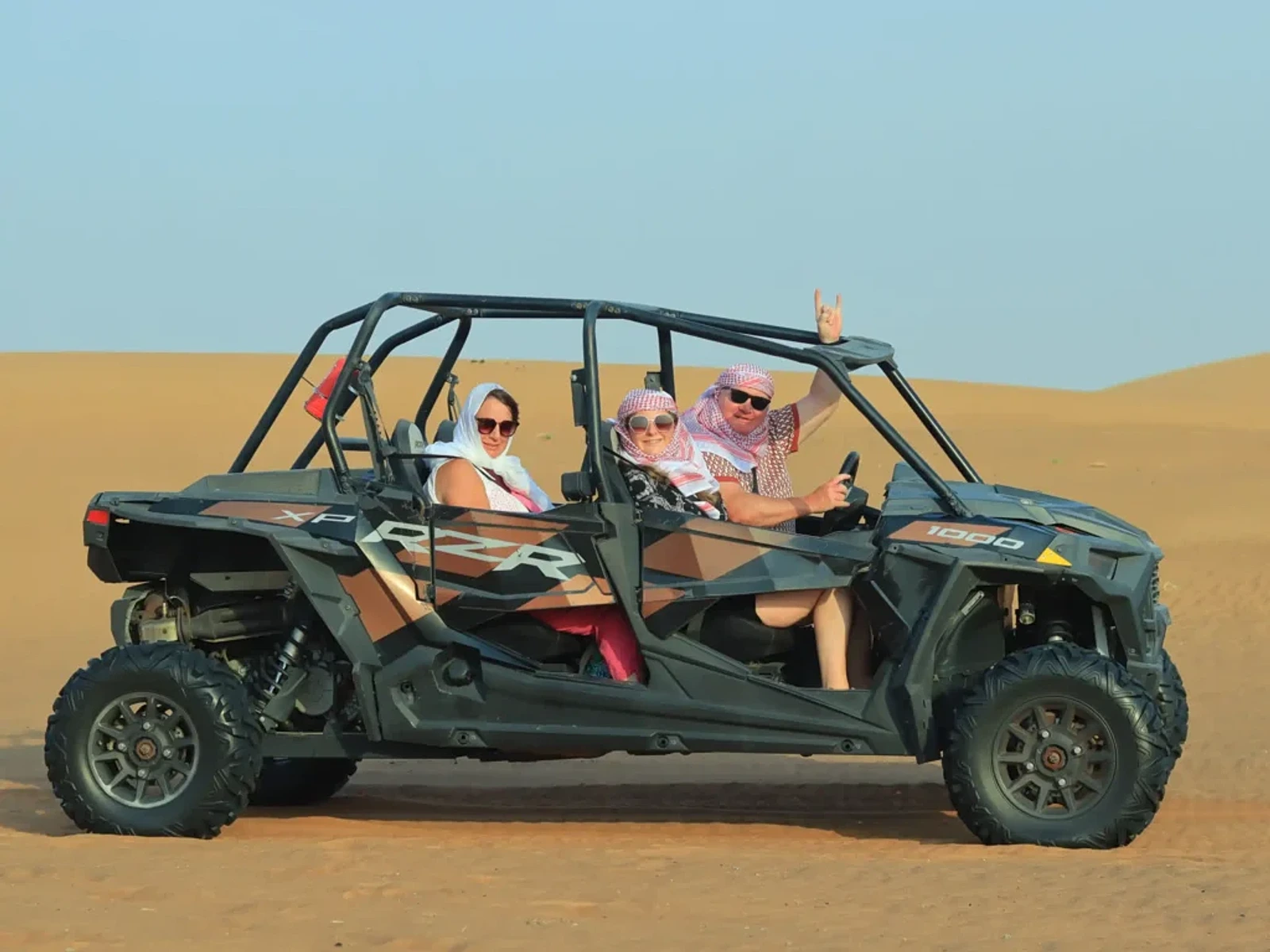
Most dune buggies in Dubai are two-seaters, but you can find models that carry four people. The trade-off is weight and agility. A four-seater buggy is heavier and will feel less nimble on sharp dune faces. If you plan to ride with a partner, a two-seater is usually the better choice for performance. If you have a family or a group of friends, two two-seaters might be more fun than a single four-seater.
Comfort matters more than you might think. The seats should have decent padding and side bolsters to keep you from sliding around. The pedal placement should feel natural, and the steering wheel should not be too far away or too close. Spend a few minutes sitting in the buggy before you commit. A cramped driving position will ruin an otherwise great day.
Rental Considerations and What to Look For
When you are looking at rental options, the condition of the buggy tells you a lot about how well it has been maintained. Check the tires for uneven wear, which can indicate alignment issues. Look at the air filter, a dirty or clogged filter is a red flag because sand ingestion can damage the engine. Ask about the maintenance schedule and whether the buggy has been serviced recently. A reputable operator will be transparent about these details.
One name that comes up often in discussions about reliable buggies in the region is Dune Buggy Rentals Dubai. They maintain a fleet that covers a range of engine sizes and suspension setups, so you can find a machine that matches your skill level and the terrain you plan to tackle. The important thing is to ask questions and not settle for a buggy that feels worn out or poorly set up.
Pre-Ride Checks You Can Do Yourself
Before you head into the dunes, there are a few simple checks that take five minutes and can save you a lot of trouble. Check the oil level on the dipstick. Make sure the coolant reservoir is full. Test the horn and the lights if you plan to ride near sunset. Walk around the buggy and look for any loose bolts or cracks in the frame near suspension mounting points.
Also confirm that the buggy has a working kill switch or tether. If you are thrown from the vehicle, the tether should cut the engine to prevent the buggy from running away. This is a basic safety feature that is sometimes overlooked. If the buggy does not have one, consider choosing a different machine.
Driving Techniques That Protect the Buggy
How you drive affects how long the buggy lasts and how safe you are. Momentum is your friend in soft sand. If you slow down too much on a climb, you risk getting stuck. Keep a steady throttle and avoid sudden steering inputs. When descending a dune, keep the buggy pointed straight and let the engine braking do most of the work. Tapping the brakes gently is fine, but locking the wheels can cause the rear end to slide out.
If you feel the buggy starting to bog down, do not floor the throttle. That only digs the tires deeper. Instead, steer gently downhill or to a firmer patch of sand. If you do get stuck, use a recovery board or a shovel rather than spinning the tires. Spinning generates heat and can damage the transmission or the tires.
Choosing the right dune buggy in Dubai is about matching the machine to the terrain, your skill level, and the kind of experience you want. Take your time, ask questions, and do not be afraid to walk away from a buggy that does not feel right. A well-chosen buggy makes the desert feel like a playground. A poorly chosen one can turn the adventure into a chore.
Dune Buggy Rentals Dubai on social media
 Facebook
 Instagram
 YouTube
 Pinterest